Are You Ready to Witness the Future of Data Security?
Platform
Resources
©2026 QuNu Labs Private Limited, All Rights Reserved.
TL;DR
Every so often, a security event resets the baseline. After it, the assumptions you held the week before no longer hold. October 2026 was one of those events.
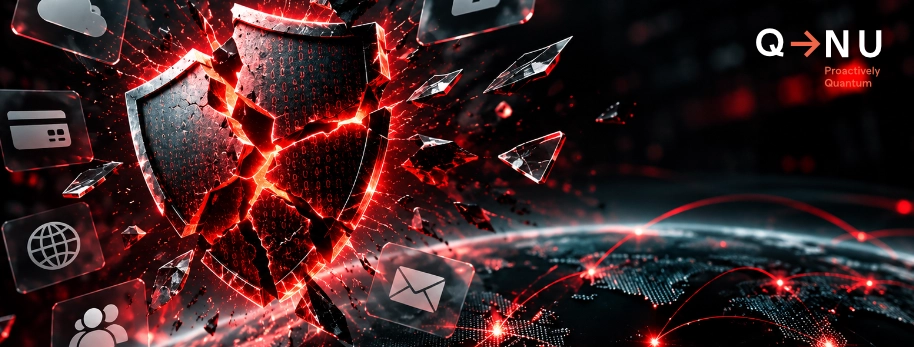
Researchers are calling it Black October. Over roughly 72 hours in the third week of the month, serious incidents landed at once: a flaw in the software behind most of the web, the collapse of trust in a major certificate authority, customer records from India’s largest bank on the dark web, poisoned developer tools, and banks locking autonomous AI agents out of customer accounts.
Any one would headline a normal year. They arrived together. Strip away the noise and most point at the same weakness: the cryptographic trust the internet runs on is more fragile than we treat it. This is a before-and-after moment for digital trust, and a small preview of a larger problem now two to three years out.
Black October is less one attack than a pile-up of disclosures, several building for months before going public between October 19 and 22.
Underneath all of it was AI. AI even found the flaw at the center of the week: the PHP vulnerabilities were uncovered by AI tooling, which the security firm Wiz called the most severe vulnerabilities the technology has yet discovered. The same autonomous agents that help developers automate real work also let attackers scan, probe and exploit at machine speed, around the clock. In the same week, JPMorgan Chase said it blocks external AI agents from operating inside retail customer accounts, with Charles Schwab and Citigroup setting similar limits, citing the risk of rogue agents.
Look at what actually broke. A certificate authority vouches for identity online: when your browser trusts a bank’s site, it trusts a chain that ends at a certificate authority. eMudhra is one of those authorities, with more than 60 million certificates issued.
Its private keys were meant to be enormous, effectively un-guessable numbers. Instead, a faulty script during an April 2025 key-generation ceremony produced keys weak enough to recover from public data in under a second. No attacker broke the math; the keys were weak from the start. Key generation combines people, scripts and hardware, so this is a risk for every certificate authority, not any one firm.
This is the point most coverage misses. The failure was not exotic. It was randomness. A key is only as trustworthy as the unpredictability behind it. When the randomness is weak, the key is guessable, and everything built on it, every certificate and encrypted session, is open.
Black October was a run of mistakes: a faulty key-generation script, unpatched flaws, exposed secrets. Fix the implementation and each goes away. The quantum threat needs no mistake at all.
A quantum computer running Shor’s algorithm breaks the RSA and elliptic-curve cryptography behind almost all of the internet, even keys generated perfectly. Certificates, VPNs, signed software and encrypted traffic all rest on it. The thread is not the cause, it is the consequence: trust breaks. Black October is that failure by accident. Quantum computing is the same failure by design.
QNu Labs chose quantum early, when that computer was 15 years away. Its current reckoning puts it two to three. The risk does not wait for the hardware: adversaries are copying encrypted data now to decrypt later, a tactic called harvest now, decrypt later. Anything with a shelf life, defence, financial records, health data, is worth stealing today even if it cannot be read yet.
The attackers are already ahead. In October 2026, Kaspersky detailed Operation FlashHole, attributed to North Korea’s Lazarus Group, targeting South Korean organizations. Its LPEClient malware now uses ML-KEM-1024, a NIST post-quantum cryptography (PQC) standard, to protect its payloads. A state-backed attacker went quantum-safe before most enterprises have.
As QNu Labs CEO Sunil Gupta puts it: “Security is not a cure you reach for after the disease. It is an immune system, built before the infection, never after.”
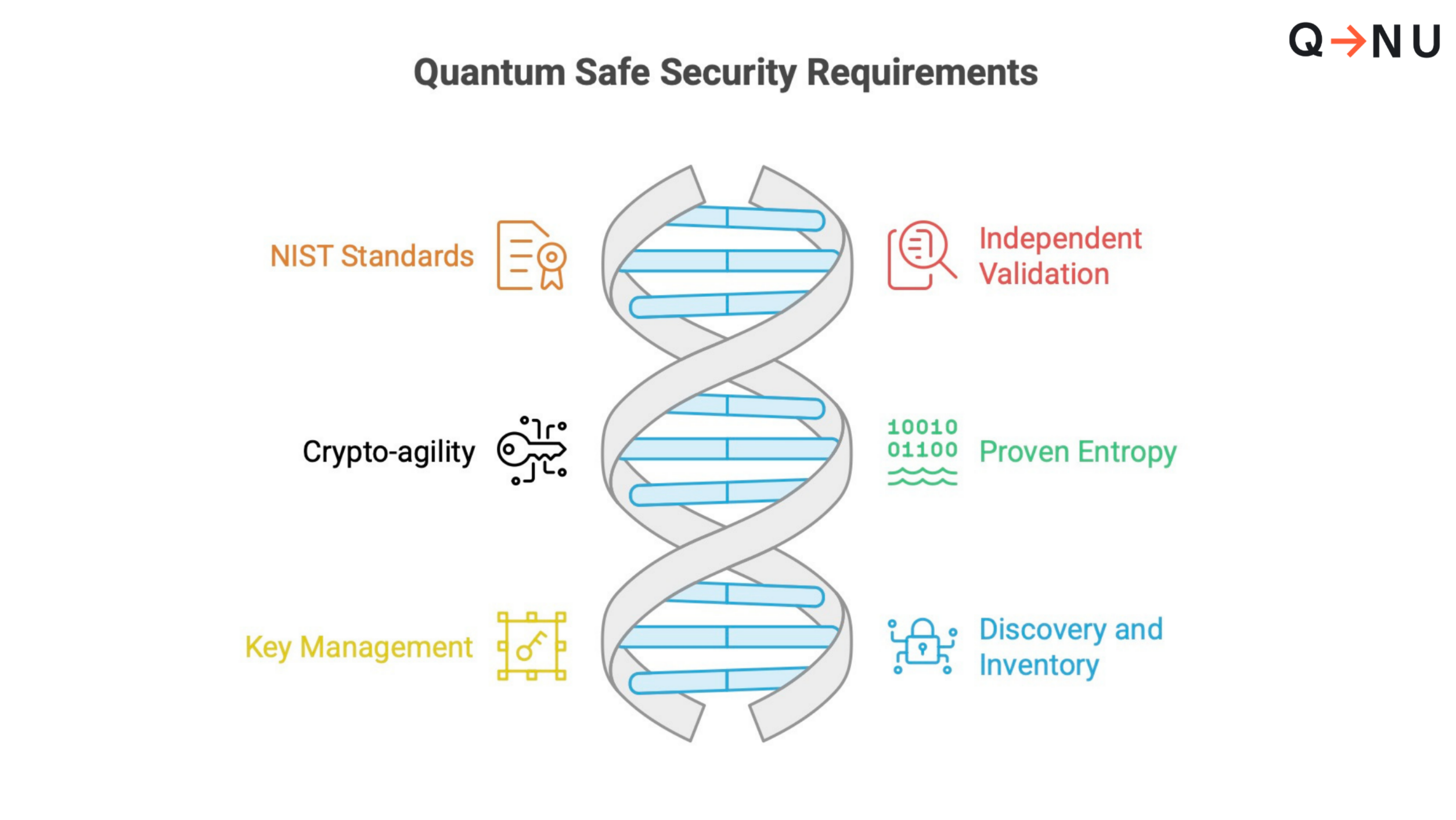
The response is a sequence, not a scramble. Whatever technology or vendor you evaluate, hold it to the same criteria:
Run it in order: adopt the standard, map and rank your exposure, migrate in phases, and bring key management onto validated, high-quality randomness.
The most exposed sectors, such as banking, finance and insurance, sit at the front of the line.
QNu Labs maps to each of these: NIST-compliant post-quantum cryptography, not proprietary algorithms; a Hodos crypto-agility layer to swap them as standards move; quantum random number generation behind its keys; and a quantum key management system to hold them. Banking, finance and insurance are first in line.
QNu Labs is the world’s only full-stack quantum security company, fully indigenous. It built India’s first 1,000 km inter-city quantum key distribution (QKD) network, and, with BISAG-N and IIT Gandhinagar, India’s first free-space QKD link at the 5.56 km scale, feeding live quantum keys into a working post-quantum application.
Black October will fade. The weakness will not.
North Korea’s hackers already encrypt their malware against the quantum era. Most of their targets have not. The data you protect with RSA today is being harvested for the day it no longer holds.
Sources: